
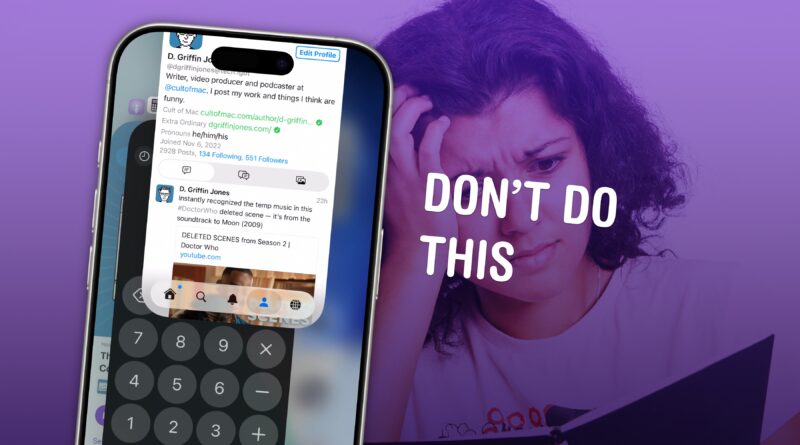
3 Reasons Why You Shouldn’t Close Open iPhone Apps
It’s good to know how to close apps on iPhone in case the app is behaving erratically or stops responding. It’s really easy – just swipe up to show your running apps and swipe up again to close them.
But does that mean you should always close your open apps? No, not at all.
Despite what you may have heard, closing apps on iOS usually makes things worse, not better. It’s a myth that closing apps will save battery life, speed up your iPhone, or free up memory. Overall, it negatively affects the performance of your iPhone.
Here’s how to close iPhone apps — plus three reasons why you shouldn’t rush it.
How to close apps on iPhone – and why you probably shouldn’t

GIF: D. Griffin Jones/Cult of Mac
To close open apps on iPhone, swipe up from the bottom of the screen and hold for a moment to reveal the app switcher. (Or on an older iPhone, double-tap the Home button.) Swipe up on any app to close it.
If the iPhone app you are using stops responding or has errors, the software will reset and the problem may be resolved. Unfortunately, many people seem to have a bad habit of violent withdrawal all open apps on their iPhones every time they use them.
You might start doing this thinking you’re saving battery or boosting your iPhone’s performance. But that couldn’t be further from the truth.
However, do it often enough and it will become a habit. But here are three reasons why you shouldn’t — and why quitting iOS apps does more harm than good.
3 Reasons Why You Shouldn’t Close Open iPhone Apps
1. Quitting apps drains your iPhone’s battery and slows it down
It may sound counterintuitive, but keeping apps running is better for your iPhone battery than closing them. When you force quit an app, your iPhone has to do extra work to kill all running processes and clear everything from memory. Then when you open the app again, the phone has to load it from scratch, which slows you down.
If you get into the habit of closing iPhone apps, the battery power you waste by closing apps and waiting for them to reopen will be far greater than the battery power needed to keep apps running in the background.
When you’re done using an app, the smart thing to do is simply return to the home screen or lock your iPhone. The device automatically clears apps from memory when needed – you don’t have to do it yourself.
2. Your apps don’t do anything in the background anyway
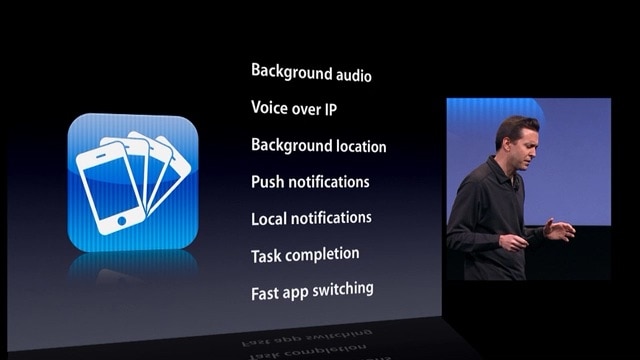
Photo: Apple
So, what actually happens when you leave an iPhone app running? If the app is not on the screen, especially if your iPhone is locked, the app can do very little. It’s as good as being fully closed without having to forcefully close them.
There are only a few things that iOS allows an app to do in the background, as former Apple executive Scott Forstall explained when iPhone multitasking was introduced:
- Stream/play audio (music, podcasts, video)
- Receive or make phone calls
- Ask for your location
- Send notifications
- Finish a task you just started, such as uploading a photo or creating a post
Pandora, Skype and TomTom were hailed as the best apps of the day to be the first to adopt these features – that was a long time ago (2010!). Apple has added a few more background features over the years, but again, none of them will appear without your knowledge:
- Run live activities that enable frequent data updates that appear on the iPhone lock screen and Dynamic Island. These also appear when you put your iPhone into standby mode, which turns your device into a smart display while charging.
- Talk to Bluetooth/NFC devices.
- Record your screen.
- Start the Deputies action.
- Start a virtual private network.
Basically, if an app isn’t on your iPhone’s screen, it doesn’t do anything. It’s just waiting for you to open it again.
3. There is a better way to stop background activity than closing iPhone apps
Screenshot: D. Griffin Jones/Cult of Mac
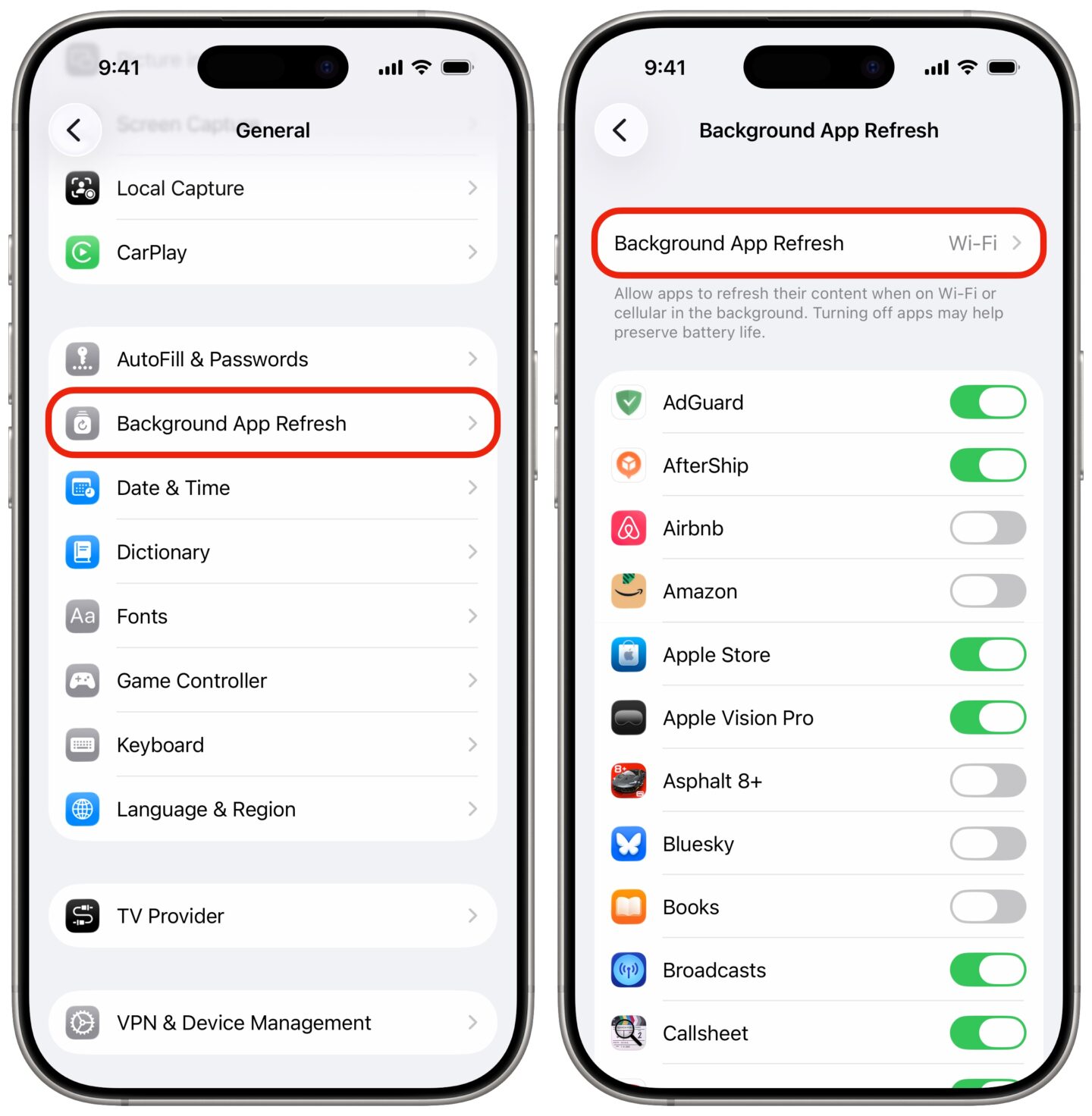
Later, Apple introduced a feature that allowed applications to update content also in the background, the so-called Background application update. Your phone judges which apps are allowed based on your usage.
If that really it’s up to you, you have one switch to prevent apps from refreshing in the background. You can turn it off in Settings > General > Background App Refresh. (Alternatively, you can set apps to only refresh in the background when your iPhone is connected to Wi-Fi.)
Once you do this, you can stop closing iPhone apps because nothing happens in the background without you knowing. But maybe it’s not worth it. Background app update is really smart when it comes to battery protection. I would only selectively disable it for the apps that are the worst: Amazon, Instagram, Snapchat, etc.
I know it’s hard to change clothes
Once you learn how to close iPhone apps, you may mistakenly think that it’s a good thing for your phone to do this all the time. For the reasons outlined above, this is definitely not the case. Force-quitting apps doesn’t save battery or speed up your iPhone — it actually drains your battery and slows down your phone.
When you’re done using the iPhone app, just swipe up to the home screen and you don’t have to worry about it.
This article on how to close iPhone apps was originally published on December 2, 2023. We updated it with the latest information on November 25, 2025.

D. Griffin Jones is a writer, podcaster and video producer for Cult of Mac. Griffin has been an avid computer enthusiast since he got his first PC in 2002 – but hasn’t turned back since he got a Mac in 2008. His graphic and web design skills, along with video and podcast editing, have been self-taught for over 20 years. Griffin has a bachelor’s degree in computer science and has written several (unpublished) apps for Mac and iOS. His vintage computer collection consists of more than 40 desktops, laptops, PDAs and devices dating back to the early 1980s. All of these creative and technical skills, along with a deep knowledge of Apple history, he brings to his work for Cult of Mac.